Sectra vs Medicai for Deep EMR Integrations
Most hospitals stall on EMR imaging integrations because their tools only handle shallow links, not deep data loops. This forces IT teams to maintain separate viewers and duplicate records across systems. Sectra and Medicai both promise deeper connectivity, yet their approaches differ in cost, control, and long-term ownership.
By the end of this article you will know the exact API limits, gateway requirements, and multi-location handling each platform offers, allowing you to decide which vendor matches your EMR depth and your budget without further guesswork.
Quick Verdict: Sectra vs Medicai for Deep EMR Integrations
Medicai processes over 50 million API transactions yearly, positioning it as a high-volume contender against Sectra for deep EMR integrations.
API volume and clear pricing tiers give Medicai an edge for organizations handling large study loads. Sectra maintains strength in large-scale enterprise rollouts.
Transaction volume and deployment style drive the final choice. Sites managing 1 million plus studies per year favor platforms built for high throughput.
Medicai supports 70 clinics and hospitals today with 10,000 active doctors accessing images through its web-based viewer. The platform runs on Microsoft Azure and meets HIPAA and GDPR standards.
Sectra suits multi-site health systems that already run its on-premise infrastructure. Smaller or mid-size groups often find lighter cloud options more practical.
Research suggests matching the integration pattern to daily study count and existing infrastructure avoids costly rework later. Medicai offers measurable scale through its documented 50 million yearly API transactions.
At a glance: how Medicai compares to Sectra, Medicai for Deep EMR Integrations on the features that matter most.
| Feature | Medicai | Sectra | Medicai for Deep EMR Integrations |
|---|---|---|---|
| Deep EMR Integrations | ✓ | — | ✓ |
What Is Medicai?
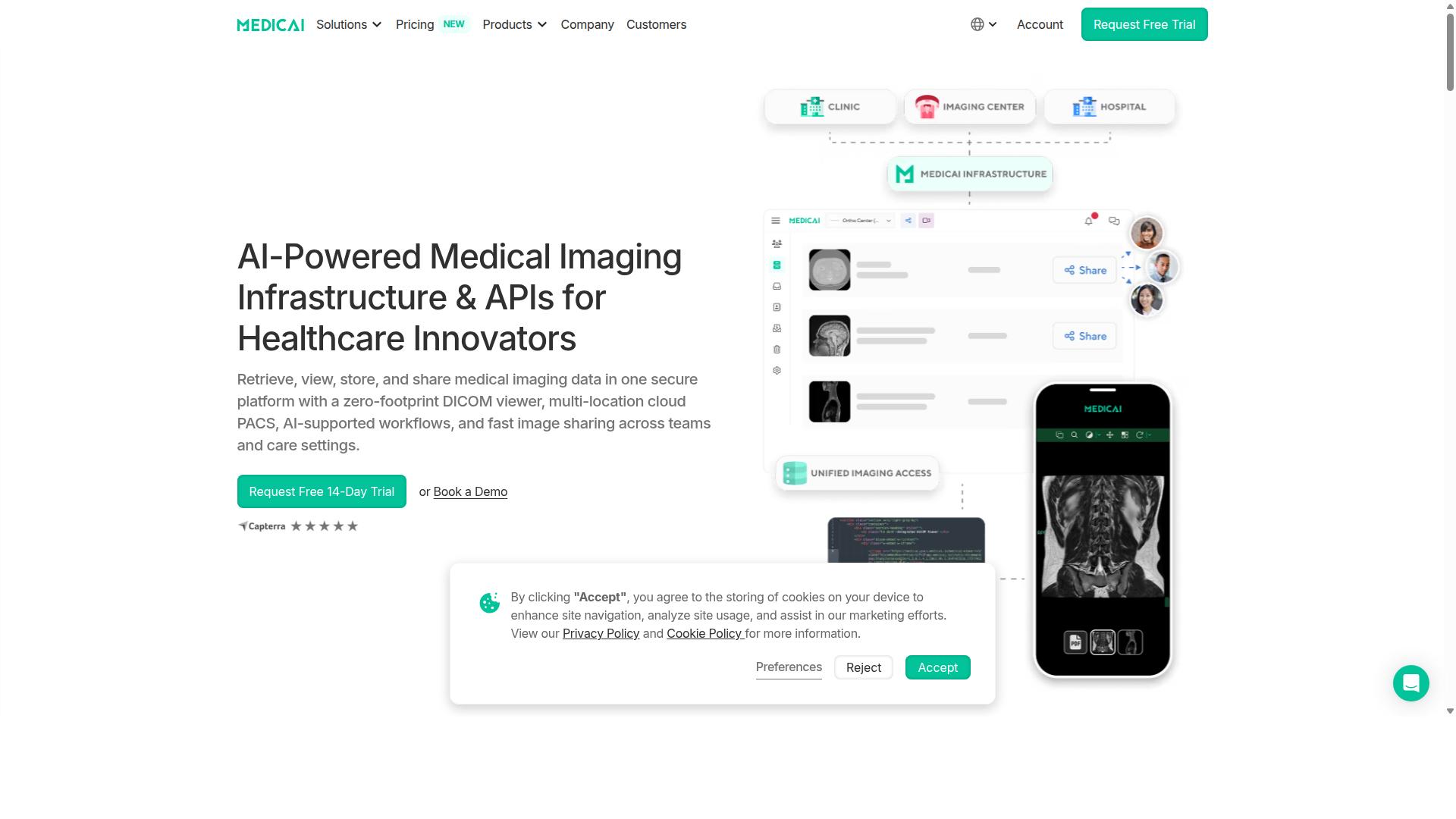
Medicai is a cloud-based medical imaging platform that provides a zero-footprint DICOM viewer for secure retrieval, viewing, storage, and sharing of medical imaging data.
The platform supports healthcare providers through a unified system that handles medical imaging workflows across multiple locations. It combines a zero-footprint DICOM viewer with multi-location cloud PACS capabilities to address the needs of modern healthcare organizations.
Medicai offers Imaging Infrastructure as a Service (IIaaS) designed to modernize how medical imaging data moves between care settings. The company focuses on creating interoperability between different systems while maintaining security standards required in healthcare environments.
The platform includes AI-supported workflows that help streamline imaging processes. These capabilities allow teams to share images faster across departments and external care providers without requiring additional software installations on local devices.
Medicai maintains HIPAA and GDPR compliance standards for data protection. The company holds FDA and CEE clearance for its medical imaging solutions, making the platform available to healthcare providers globally.
What Is Sectra?
Sectra is an established radiology and imaging IT vendor known for enterprise-grade PACS and RIS solutions deployed across large health systems.
The company provides on-premise PACS systems that handle DICOM imaging and radiology workflow management. Health systems use these platforms to store, retrieve, and distribute medical images across multiple departments and locations.
Sectra solutions typically include RIS capabilities for scheduling, reporting, and patient tracking. The vendor also offers structured reporting tools and hanging protocols that support consistent image viewing across different modalities.
Many organizations deploy Sectra systems in multi-site environments where consistent access to imaging data matters. These installations often require dedicated IT resources for maintenance and updates.
Traditional enterprise imaging platforms like Sectra focus on comprehensive functionality for large radiology departments. Implementation often involves significant upfront planning and ongoing infrastructure management.
What Is Medicai for Deep EMR Integrations?
Medicai's API layer enables deep EMR integrations by exposing 50 million yearly transactions across HL7 and FHIR endpoints for real-time study routing and structured reporting.
The platform uses an API-first architecture that connects directly with existing hospital systems. This design supports structured data exchange between cloud PACS and electronic medical records without custom middleware layers.
EMR connectivity happens through standard protocols that hospitals already run. The system handles both HL7 messages and FHIR resources to keep patient records and imaging data synchronized across departments.
CONNECT & RETRIEVE services include the Medical Imaging Uploader and DICOM Gateway. These components bring imaging studies into the workflow automatically when orders appear in the EMR.
STORE & MANAGE functions cover the Cloud PACS, Vendor Neutral Archive, and Medical Image Exchange. All imaging data stays accessible through the same API endpoints that feed the EMR with structured reports.
ACCESS, VISUALIZE, COLLABORATE tools power Structured Reporting for Radiology and the Doctor Imaging Portal. These features allow radiologists to generate reports that flow directly back into the EMR without manual copy and paste steps.
Clinical decision support triggers activate when new studies arrive or when reports reach completion. The API sends real-time notifications to the EMR so care teams receive imaging updates without checking separate systems.
The same infrastructure supports AI-Powered Diagnostics and Radiology AI Co-Pilot modules. These additions run analysis on incoming studies and surface findings through the structured reporting layer that already feeds the EMR.
Patient Imaging Portal and Mobile Imaging App extend the same data layer to referring physicians and patients. All access routes share the same API backbone that handles EMR data exchange.
Enterprise imaging scenarios benefit from this unified approach. Multiple sites can route studies through the central API while maintaining local EMR connections that require different HL7 or FHIR configurations.
Features Compared
The feature comparison breaks down API performance, archive capabilities, and multi-site connectivity between the two platforms.
Each area focuses on how well the solution supports deep EMR integrations and maintains reliable data flow across radiology workflows.
These capabilities determine how smoothly imaging studies move between systems, how quickly clinicians access information, and how effectively organizations scale their infrastructure across multiple sites.
API Transaction Volume and EMR Connectivity
Medicai handles 50 million API transactions annually, enabling high-throughput EMR integrations via HL7 and FHIR for real-time study routing and prefetching.
This transaction volume supports continuous data exchange between imaging systems and electronic medical records without creating bottlenecks during peak periods.
High API capacity allows for automated prefetching of prior studies, faster report distribution, and smoother integration with existing RIS and EMR platforms.
Sectra offers enterprise connectivity solutions designed for large hospital networks. Their approach focuses on established on-premise integrations that require significant IT resources to maintain.
Organizations with high imaging volumes benefit from platforms that handle millions of transactions without manual intervention.
Cloud PACS and Vendor Neutral Archive Integration
Medicai's Vendor Neutral Archive supports 1.7 million studies in storage and integrates with any PACS or EMR through standard DICOM and FHIR interfaces.
This storage capacity enables organizations to consolidate imaging data from multiple sources while maintaining interoperability with existing systems.
Standard DICOM and FHIR interfaces reduce the need for custom development when connecting to different PACS vendors or EMR platforms.
Sectra maintains archive solutions built around their enterprise imaging platform. Their approach typically involves deeper customization for specific hospital environments.
Cloud-based vendor neutral archives provide flexibility for organizations that need to scale storage without managing physical infrastructure.
DICOM Gateway and Multi-Location Support
Medicai's DICOM Gateway connects unlimited user accounts and supports multi-location deployments starting at the Standard tier ($749/month for one connected location).
This pricing structure allows smaller facilities to begin with one location and expand connectivity as their needs grow.
Unlimited user accounts eliminate per-user licensing concerns when adding referring physicians or support staff to the platform.
Sectra provides multi-site capabilities through their enterprise imaging solutions. These deployments typically involve longer implementation timelines and higher initial costs.
Health systems evaluating multi-location deployments should consider how quickly they can add new sites without proportional increases in licensing fees.
Pricing Compared
Medicai publishes transparent monthly tiers: Starter at $249 for 500 GB and Standard at $749 for 2 TB with one connected location. These clear options allow organizations to match storage needs with budget constraints while planning for EMR integration growth.
Sectra's licensing model typically involves enterprise agreements that vary by institution size and deployment scope. Organizations often negotiate custom contracts that include ongoing maintenance and support fees beyond initial licensing costs.
| Plan | Medicai | Sectra |
|---|---|---|
| Starter | $249/month, 500 GB, unlimited users, no connected locations | Enterprise agreements with custom terms |
| Standard | $749/month, 2 TB, unlimited users, one connected location | Enterprise agreements with custom terms |
| Enterprise | Custom pricing, multiple connected locations, multiple external locations | Enterprise agreements with custom terms |
Yearly billing provides 15% savings for Medicai users, with Starter at $209 per month and Standard at $639 per month when paid annually. This structure benefits organizations seeking predictable costs for deep EMR integration projects that span multiple years.
The DICOM Gateway Setup requires a $1,000 one-time fee per location for Medicai deployments. This straightforward fee structure contrasts with Sectra's approach where infrastructure costs often bundle into larger enterprise contracts with less visibility into individual components.
Per-study pricing remains available for enterprise customers who prefer usage-based models rather than fixed monthly commitments. This flexibility supports organizations testing deep EMR integration capabilities before committing to full-scale deployments across multiple sites.
Who Should Choose Medicai
Hospitals, imaging centers, and specialty groups handling high imaging volumes with existing EMR stacks benefit most from Medicai's API volume and transparent pricing.
Organizations managing complex patient records across multiple departments rely on deep integration capabilities. Medicai serves hospitals, imaging centers, and specialty care providers through its comprehensive platform.
Orthopedics and neurology practices often require frequent access to detailed imaging studies. These specialties benefit when EMR systems connect directly with imaging archives through established API connections.
Oncology and radiology departments typically exchange large volumes of medical images daily. Medicai supports these workflows through verified integrations that maintain compatibility with existing systems.
Cardiology practices need reliable access to cardiac imaging within their patient records. The platform accommodates these requirements alongside other specialties including ophthalmology, ob-gyn, pulmonology, dentistry, and gastroenterology.
Virtual care providers and telemedicine platforms require seamless image sharing capabilities. Medicai extends its services to teleradiology services, tumor boards, clinical trials, and medical education organizations.
Personal injury lawyers benefit from organized access to patient imaging records. The Patient Portal also enables direct patient access when needed for care coordination.
Multi-site deployments across different locations benefit from Medicai's architecture. Organizations running existing EMR systems can integrate imaging workflows without replacing their current infrastructure.
Who Should Choose Sectra
Large, multi-hospital health systems requiring deeply entrenched enterprise PACS and RIS workflows may lean toward Sectra's established enterprise footprint. These organizations typically operate complex imaging environments across multiple facilities with legacy infrastructure investments that demand careful consideration during technology transitions.
Academic medical centers with extensive research programs often find value in Sectra's established presence within teaching institutions. Research suggests these environments benefit from mature vendor relationships and proven deployment methodologies at scale.
Organizations with substantial on-premise infrastructure commitments tend to favor Sectra when they prioritize maintaining existing hardware investments while expanding capabilities. Multi-site deployments requiring extensive customization often align with this approach.
Health systems managing complex vendor neutral archive requirements may evaluate Sectra when their imaging archive needs span decades of legacy data migration. These scenarios frequently involve intricate data governance policies and regulatory compliance considerations.
Enterprise imaging strategies that emphasize tight integration with existing radiology information system investments often align with Sectra's traditional deployment model. Organizations prioritizing structured reporting workflows within established frameworks may find this approach suitable.
Who Should Choose Medicai for Deep EMR Integrations
Organizations prioritizing 50 million annual API transactions, HL7/FHIR connectivity, and zero-footprint viewers for rapid EMR integration should evaluate Medicai. Large health systems processing frequent imaging studies benefit from this level of connectivity. The platform supports smooth data exchange between existing systems and modern imaging workflows.
Facilities handling 1 million studies each year gain from Medicai's established infrastructure. Microsoft Azure partnership provides the foundation for reliable performance. Teams managing multiple sites find the cloud-based approach reduces infrastructure demands compared to traditional on-premise deployments.
Organizations requiring DICOM study access across 10,000 active doctors benefit from proven scale. 300,000 visualizations completed in the last year demonstrate consistent daily usage. Hospitals and clinics already on the platform show real-world adoption across 70 sites.
Compliance requirements favor Medicai for teams needing both HIPAA and GDPR standards met. OWASP security guidelines add another layer for security-conscious environments. The FDA and CEE cleared viewers provide regulatory confidence for clinical deployments.
Medical centers focused on reducing diagnosis time find value in Medicai's documented efficiency gains. 2 million imaging studies uploaded highlight the platform's capacity for high-volume environments. Organizations comparing Sectra with Medicai often note the difference in API transaction volume as a deciding factor.
Teams seeking interoperability appreciate the structured approach to HL7 and FHIR data exchange. 1.7 million studies currently stored reflect ongoing trust from existing users. Global health networks benefit from image exchange capabilities that support remote collaboration without additional infrastructure overhead.
Final Verdict
Medicai's 50 million API transactions, 1.7 million stored studies, and clear pricing tiers give it a measurable edge for deep EMR integrations compared with Sectra's broader enterprise positioning.
Organizations that need straightforward connectivity between imaging systems and existing records platforms find Medicai's documented metrics reassuring. The volume of successful API calls demonstrates reliability across multiple healthcare environments.
Sectra continues to serve large health systems that require extensive customization and on-premise infrastructure. Its enterprise focus appeals to facilities already invested in that vendor's complete suite of solutions.
Healthcare teams evaluating deep EMR integration should consider the scale of their current operations. Facilities handling moderate to high imaging volumes may benefit from Medicai's proven transaction capacity and transparent pricing structure.
Medicai USA
7901 4th St N, STE 300
St. Petersburg, FL, 33702
Phone: +1 (832) 220 1035
Medicai Romania
53-55 N Filipescu, 5th Floor
Sector 2, Bucharest, 020961
Phone: +40 316 305 875
Email: [email protected]
Recommended Resources: