Top 4 Alternatives of Sectra for Cloud PACS
Many radiology teams hit limits on Sectra when they need faster image sharing across several sites or easier access for outside referring physicians. These gaps appear as soon as new locations join the network or when mobile specialists request studies on short notice. The four solutions reviewed here all address those exact issues.
By the final section you will see how Medicai stacks up against Studycast, PostDICOM, and UltraLinq on workflow speed, multi-location support, and total cost of ownership, so you can pick the platform that fits your current caseload and expansion plans.
What to Look For in a Cloud PACS Alternative to Sectra
Evaluate cloud PACS alternatives by examining integration capabilities, security standards, and scalability features before committing to a platform.
Start with interoperability requirements. Medical imaging systems must exchange data across different hospital networks and departments.
Review the following technical checklist when comparing options to Sectra for radiology workflow and diagnostic imaging needs.
- HL7/FHIR API support for EMR connectivity and RIS integration
- Zero-footprint viewer availability for multi-site access without local software installation
- DICOM compliance levels for consistent image archive functionality
- Data sovereignty options to meet regional healthcare IT regulations
- Minimum uptime percentages with documented SLA commitments
- Role-based access controls and audit logging for data security
- Encryption standards for both data at rest and data in transit
Confirm each requirement against your specific enterprise imaging environment before making a final decision.
1. Medicai - Best Overall
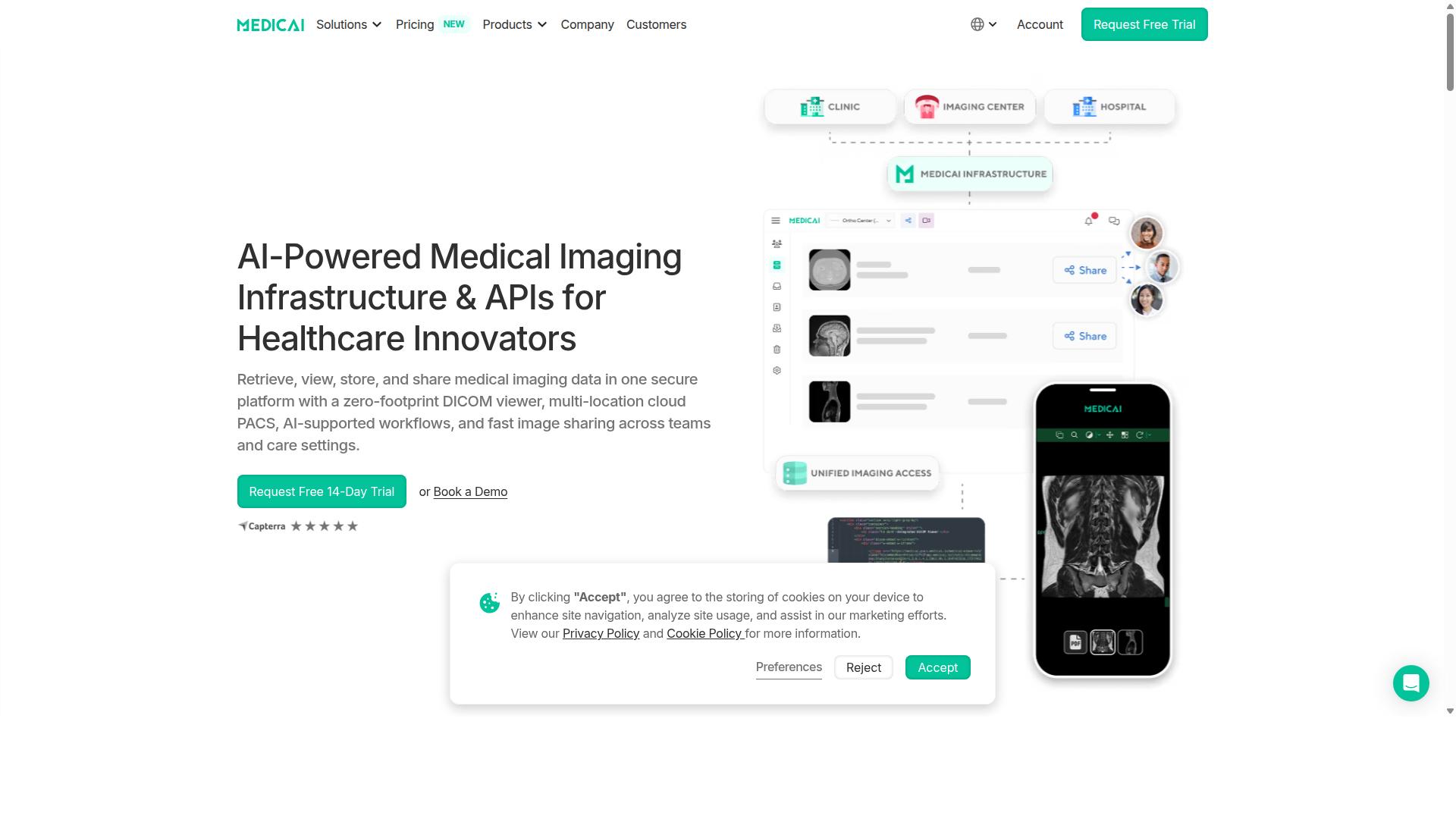
Medicai delivers a unified cloud platform that combines medical imaging retrieval, storage, and collaboration in one HIPAA-compliant system. This approach addresses the key evaluation criteria for Cloud PACS alternatives to Sectra. The platform serves as a complete medical image management solution.
Healthcare providers gain access to a single environment for their entire diagnostic imaging workflow. The system supports multi-site access while maintaining data security standards. This unified structure eliminates the need for separate tools across different imaging functions.
Organizations can integrate their existing healthcare IT infrastructure through standard protocols. The platform handles image sharing across care teams and external providers. This capability supports teleradiology requirements and enterprise imaging needs.
Key Features and Capabilities
The platform provides a zero-footprint DICOM viewer with FDA/CEE clearance. This viewer operates without local software installation while maintaining diagnostic quality standards. Users access studies from any web-enabled device with appropriate security credentials.
Medicai processes over 1M studies each year and maintains 1.7M studies in cloud storage. The system handles 50M API transactions annually, enabling integrations with existing hospital systems. These volume metrics demonstrate the platform's capacity for enterprise-level medical imaging operations.
The solution supports HL7 integration and FHIR API connectivity for EMR connectivity. Role-based access controls and audit logging maintain data security across all user interactions. The platform follows OWASP security guidelines and maintains HIPAA and GDPR compliance standards.
Pricing and Value
Two tiers start at $249/month for the Starter plan offering 500 GB storage and unlimited user accounts. The Standard plan costs $749/month and includes 2 TB storage plus one connected location. Both plans provide annual billing options with 15% savings.
Enterprise customers receive custom pricing based on storage requirements and multiple location connectivity needs. DICOM Gateway Setup requires a one-time fee of $1,000 per location. Per-study pricing becomes available for organizations with specific volume requirements.
The pricing structure accommodates different practice sizes and imaging volumes. A 14-day trial of Starter plan features allows evaluation without credit card requirements. This approach enables healthcare organizations to assess the platform's fit for their radiology workflow needs.
2. Studycast
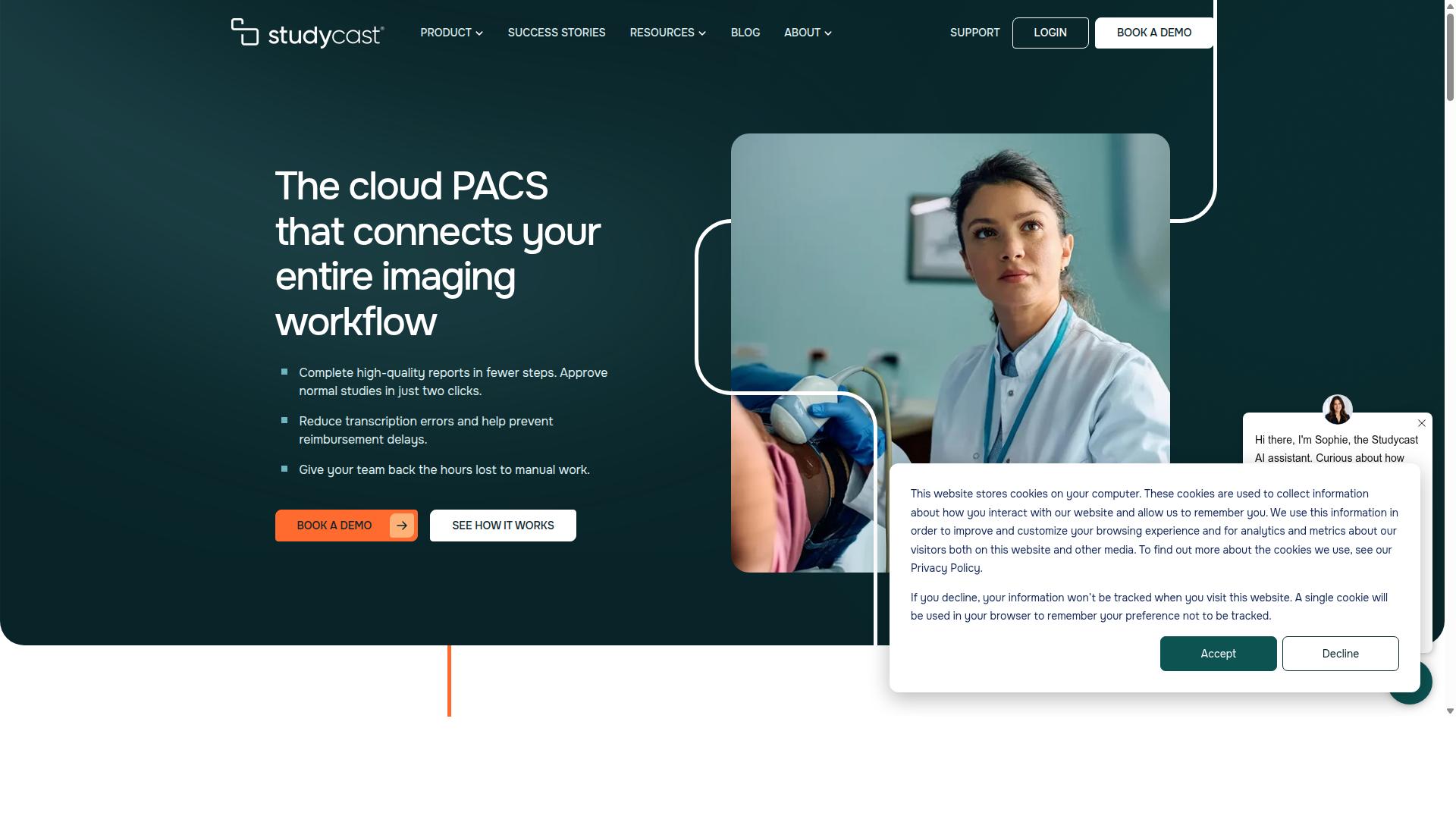
Studycast operates as a cloud-based PACS solution focused on cardiology and radiology imaging workflows. The platform manages studies across ultrasound, nuclear imaging, X-ray, and MRI modalities through a centralized digital environment. Healthcare facilities use this system to handle their diagnostic imaging needs without maintaining physical servers on site.
Many private practices and multi-location enterprises select this option when they need reliable image management. The service supports physicians, sonographers, administrators, and IT professionals who require consistent access to patient studies. Organizations that perform point-of-care imaging or operate ambulatory surgery centers often find this approach suitable for their daily operations.
Academic research settings and mobile imaging services represent additional user groups that benefit from this cloud model. The system accommodates various healthcare delivery environments where staff members need to review and report on studies from different locations throughout the day.
Key Features and Capabilities
The platform offers standard PACS functionality with web-based access and basic DICOM viewing tools. Users can store, review, and report studies through structured reporting templates that follow established clinical workflows. Workflow automation features help reduce the steps required between image acquisition and final report completion.
Image sharing capabilities allow authorized users to exchange studies with referring physicians and specialists. EHR integration connects imaging data with existing patient records, while HIPAA-compliant sharing ensures patient information remains protected during transmission. The system supports over 140 study types across multiple medical specialties.
Typical deployment scenarios include office-based labs, hospitals, and veterinary practices that require diagnostic imaging capabilities. The solution accommodates role-based access controls that assign different permissions to physicians, technologists, and administrative staff. These features address common requirements found in radiology departments and cardiology practices seeking cloud-based alternatives to traditional on-premise systems.
3. PostDICOM
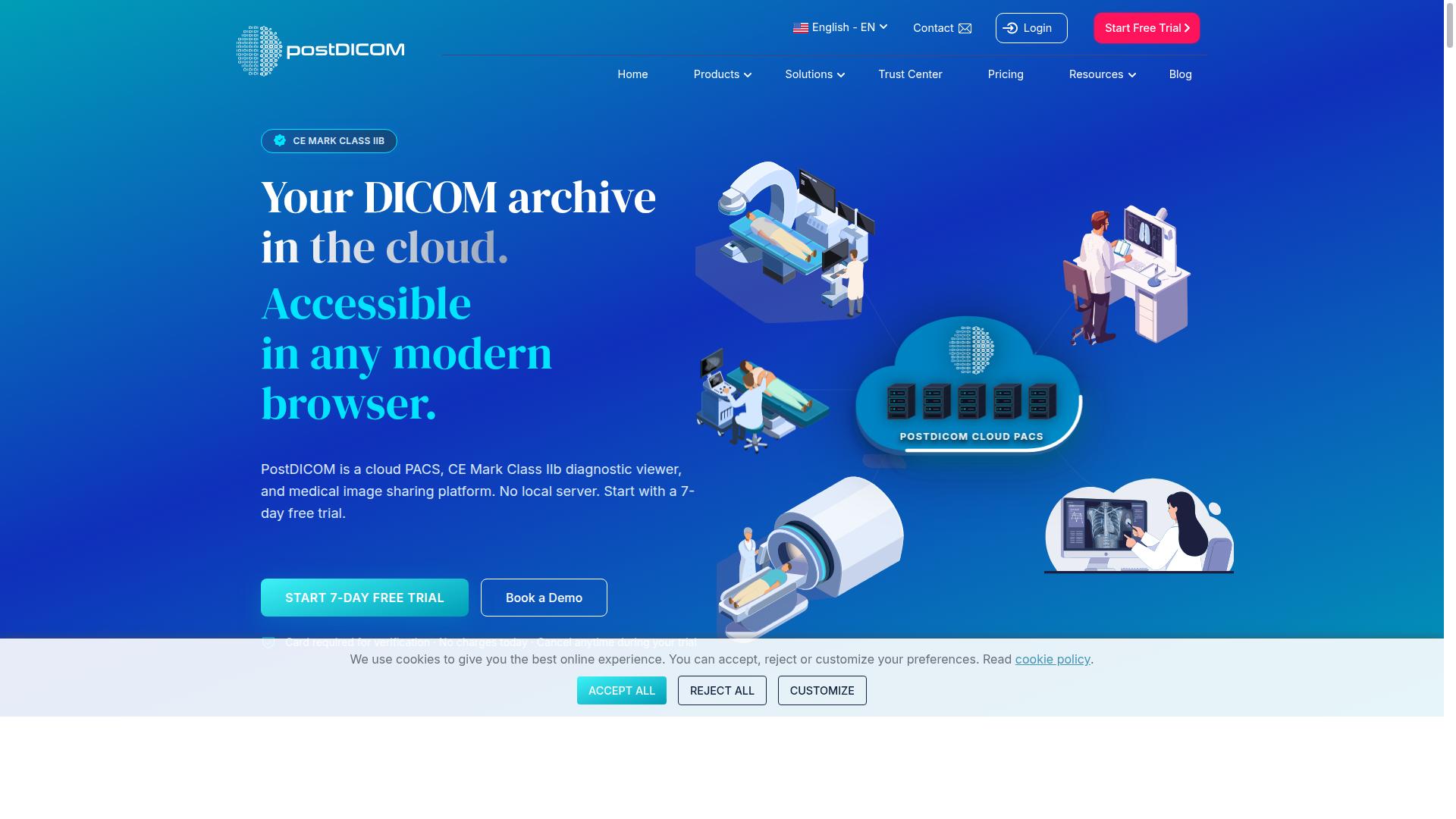
PostDICOM provides browser-based DICOM viewing and cloud storage for medical imaging files. This platform operates as a cloud PACS solution that addresses the needs of facilities seeking alternatives to Sectra. Medical practices can access their imaging data through standard web browsers without additional software installations.
The service stores medical imaging data across multiple Microsoft Azure regions. This distributed approach supports data security and disaster recovery requirements common in healthcare IT environments. Organizations can evaluate the platform through a 7-day trial period before committing to regular use.
PostDICOM serves various medical specialties including hospitals, clinics, and teleradiology practices. Veterinary offices and dental practices also utilize the platform for their diagnostic imaging needs. The system supports research institutions and teaching facilities that require structured image archives.
Key Features and Capabilities
Users access studies through web browsers with standard DICOM viewing and basic annotation tools. The zero-footprint HTML5 viewer enables multiplanar reconstruction, 3D volume rendering, and maximum intensity projection capabilities. These tools support diagnostic workflows without requiring specialized workstation hardware.
The platform accommodates multiple medical imaging formats and enables image sharing through password-protected links. Medical professionals can collaborate on cases by sharing specific studies with colleagues or referring physicians. This sharing function streamlines consultation processes between different healthcare providers.
PostDICOM includes compliance certifications such as HIPAA, GDPR, ISO 13485, and ISO 27001. The platform also holds CE Mark Class IIb certification for diagnostic use. Teaching libraries within the system support university programs and medical education initiatives.
4. UltraLinq
UltraLinq delivers cloud PACS services primarily targeting ultrasound and echocardiography workflows. The platform focuses on cardiac imaging specialties while supporting broader enterprise imaging needs across multiple departments. Medical imaging professionals use this solution for remote access to patient reports and images from any internet-connected device.
Cardiology departments benefit from specialized workflows that streamline daily operations. The system serves cardiologists, sonographers, vascular specialists, imaging administrators, rural clinics, hospitals, family practices, and women health centers. Research institutions and imaging schools also rely on this platform for educational purposes.
UltraLinq supports multi-site access requirements common in modern healthcare IT environments. The solution handles diagnostic imaging demands across various practice sizes and specialties. Security features include enterprise-grade measures designed for medical data protection.
Key Features and Capabilities
The platform specializes in ultrasound workflow management with cloud-based storage and viewing capabilities. Users access mapped reports and customizable worksheets that reduce reporting time. Post-processing analytics help clinicians extract meaningful insights from imaging data.
Cardiology workflow integration includes measurement tools tailored for echocardiography studies. Report generation features allow personalized branding while maintaining professional standards. The system supports three-click worksheet customization that adapts to different procedural requirements.
Enterprise security measures encompass multi-factor authentication and single sign-on capabilities. Interface options include both light and dark display modes for user preference. The platform handles large volumes of medical image management across distributed healthcare networks.
UltraLinq addresses radiology workflow challenges through cloud storage solutions. Organizations can scale storage capacity based on growing imaging volumes. The solution maintains compatibility with existing healthcare IT infrastructure for seamless data exchange.
How to Choose the Right Option
Match platform capabilities to your organization's imaging volume, specialty requirements, and integration needs. Healthcare providers evaluate storage capacity first, then examine how each system connects with existing workflows across departments.
Hospitals typically require multi-site access and enterprise imaging capabilities. Imaging centers focus on throughput and image sharing features that support faster turnaround times for referring physicians.
Specialty practices have distinct priorities. Orthopedics and neurology groups often need 3D reconstruction tools, while oncology and cardiology practices prioritize hanging protocols and structured reporting that align with their diagnostic processes.
Connectivity requirements vary by setting. Teleradiology services and virtual care providers examine zero footprint viewer options, while clinical trials and tumor boards assess how platforms support secure image sharing with external stakeholders.
Storage requirements depend on annual volume and retention policies. Organizations should calculate their current capacity needs and project growth over three to five years before selecting a vendor neutral archive solution.
Integration complexity influences long-term satisfaction. Systems that support HL7 integration and FHIR API connectivity reduce implementation time and ongoing maintenance costs for radiology software environments.
Security and compliance factors matter for every provider type. HIPAA compliance, data encryption, audit logging, and role-based access controls form baseline requirements across healthcare IT implementations.
Disaster recovery capabilities and uptime SLA commitments protect against data loss. Organizations should review each platform's backup frequency and recovery time objectives before making final selections.
Scalability becomes critical as imaging volumes increase. Cloud storage solutions offer advantages for multi-site access and remote reading scenarios that traditional on-premise systems may not accommodate efficiently.
Final Verdict
Organizations prioritizing comprehensive integration, scalable storage, and proven transaction volumes should evaluate Medicai's unified platform. The system handles 1M+ studies processed annually while maintaining 1.7M+ studies in active storage.
Compliance requirements form a critical checkpoint for any Cloud PACS selection. Medicai operates under HIPAA and GDPR standards while providing FDA and CEE cleared viewers that meet strict regulatory expectations.
Transaction scale offers another reliable indicator of platform maturity. Medicai processes 50M+ API transactions yearly and supports multi-site access across 70 clinics and hospitals with 10,000+ active doctors.
Security protocols align with industry standards through OWASP guidelines and data encryption practices. The platform maintains role-based access controls and audit logging to protect patient information throughout the radiology workflow.
Storage capacity demonstrates proven reliability with 2M+ imaging studies uploaded to date. This volume reflects consistent performance in medical image management without compromising diagnostic imaging quality or access speed.
Integration capabilities support EMR connectivity and HL7 integration requirements common in healthcare IT environments. The Microsoft Azure partnership provides additional infrastructure stability for enterprise imaging deployments.
Interoperability features enable image sharing across different systems while supporting teleradiology workflows. These capabilities reduce diagnosis time by 65% for organizations managing complex medical imaging requirements.
Recommended Resources: